Jason Henderson's FB Feed

Wednesday, March 28, 2012

James Bond Comic Strips!

I just got my hands on a cool item from Titan: The James Bond Omnibus Volume 003 collects daily James Bond comic strips from the 1960s. Very, very cool, and I love the way these stories play out in a sense more like a TV version of Bond, with Bond co-ordinating efforts with Moneypenney, investigating more, etc. Check it out!

 Description:
The daring James Bond is back in a definitive bumper edition collecting the first period of Jim Lawrence's celebrated run in comic strip form! Includes seven of Bond's most thrilling and dangerous missions: The Harpies, River of Death, The Golden Ghost, Fear Face, Double Jeopardy, Starfire and Kingley Amis' controversial post-Fleming story, Colonel Sun.

Friday, March 16, 2012

Dark Shadows 2012 looks AMAZING

Johnny Depp as Barnabas in the upcoming gothic satire Dark Shadows.
Dark Shadows from Tim Burton is going to be funny, and I'm thrilled. At first I kind of hated that idea-- I wasn't a big fan at first of Burton's MARS ATTACKS, for instance. But Burton clearly seems to be bringing a glorious appreciation of the famous gothic soap opera to the big screen. It looks gorgeous. If you're still a fan of the original-- or want to know what it's all about-- you can find every episode on Netflix. But the Burton/Depp Dark Shadows should probably please the fans by not at all competing with the original, and instead acting as a kind of massive skit about it. Good enough for me!

See my review of the first super-serious, super-Gothic Dark Shadows movie, Night of Dark Shadows.
Dark Shadows opens May 11, 2012.    

Monday, March 5, 2012

Cover Reveal: Alex Van Helsing: The Triumph of Death

There is a painting in Madrid that holds the key to a coming Apocalypse, and only Alex Van Helsing and a mysterious motorcycle-riding witch can unlock its mysteries.

Are you ready for more Alex Van Helsing? Finally I can reveal the cover of Book 3, The Triumph of Death-- to me, the best of the three books planned so far. In Book 1, Alex joined the spy organization the Polidorium. In Book 2, Alex had to balance breakneck spy action with girl trouble galore, and the pace picked up considerably. Now in Book 3 it's wall-to-wall suspense and action, with new bad guys, new organizations, and (surprise) a new girl-- a 14-year-old witch/spy who can give Alex and his motorcycle a run for their money.

But at the book's heart is a painting-- a kind of amazing one. I'll be posting more on that soon, but for now, here's the cover of Alex Van Helsing: The Triumph of Death, coming in hardback July 24, 2012!

If you find this interesting-- and if you dig the awesome green colors-- pre-order now and pass it on!

Alex Van Helsing: The Triumph of Death (HarperTeen, July 24, 2012)


Saturday, February 25, 2012

PSJA ISD Visits

Posters by the students of PSJA North HS on
the many topics of the Alex Van Helsing series.
This may well be the first-ever triptych on the live of
Dr. John Polidori.
Gang, I had a great week. I spent the past week visiting schools in the PSJA (Pharr-San Juan- Alamo) ISD in Texas, visiting no less than fifteen schools:

  • LBJ Middle School
  • PSJA North HS
  • Sotomayor HS
  • SW-Escalante MS
  • Kennedy MS
  • Liberty MS
  • San Juan Middle
  • PSJA High 
  • Alamo Middle
  • Austin Middle
  • CTA/ Options HS
  • Buell Central HS
  • T-STEM Jeff. HS
  • Memorial HS
  • Audie Murphy Middle

I had such a fantastic time. One thing that PSJA ISD did that was new to me was the make the author visit into a reward for readers. Generally the only students who attended were those who had read enough to qualify and had even read Alex Van Helsing: Vampire Rising (proven, believe it or not, by passing an Alex Van Helsing Accelerated Reader test.) The result: these kids were motivated and wonderful, and I spent five days surrounded by students full of questions. We talked about books, writing, vampires, and Alex, and a bunch of other stuff.

At Costa Messa in McAllen with book distributor
Pat Anderson of Overlooked Books.


And check it out! San Juan Middle School's librarian, Minnie Lazo, posted an Animoto video regarding one visit that I really enjoyed!

Thanks PSJA ISD-- especially Ms. Nora Galvan, the Media Director who made it all possible!


Sunday, February 12, 2012

Tales from Development Hell

I'm a real sucker for books about the history of movies-- particularly those that detail intricate stories about how projects  came together-- or sometimes didn't. (My taste for these things goes all the way back to the Medved Brothers' Golden Turkey Awards, the grandfather of bewildering backstage stories, among other things.)
I just got a new book called Tales from Development Hell by David Hughes and it's chock full of geeky movie "unhistory." For instance there's a whole chapter on various versions of Lord of the Rings, and a chapter on "The long road to Batman Begins" with details bout Darren Aronofsky's Batman Year One project.
Ever wonder why it took so long to get a reboot of Planet of the Apes going, or what went wrong with Tim Burton's version? There is a whole chapter on that here, too. The new version of the book is updated (for instance, a version I read a few years ago hadn't yet contemplated Rise of the Planet of the Apes, whereas this one does. I love this book.  Definitely check it out!
 

Wednesday, February 8, 2012

The Podcast Kind of Goes Off on Bram Stoker's Dracula

The Castle Dracula Podcast has returned with BRAM STOKER'S DRACULA (1992), and we kind of go off on it. Or at least I do; we have Drew Edwards defending and Tony Salvaggio in the middle. I think I called it the biggest disappointment since The Avengers (1998) at some point. 


Hear the new episode of the Castle Dracula Podcast:

Monday, January 23, 2012

Remembering Sylvia Faust

Oh. My. Gosh.
Over at Comics Bulletin, Daniel Elkin spends a whole column reminiscing about Sylvia Faust, the "magical romantic comedy" I wrote and Greg Scott drew for Image Comics. It was about a magic-using girl who joins the staff of a crazy 24-hour movie house patterned after a certain indy theater in Austin.


After issue two, I'm sure I'll want to introduce this comic to my parents. Maybe after issue three we'll talk about moving in together. After issue four I'll find myself lingering in front of jewelry store windows eying rings I can't possibly afford. After issue five . . . Oh . . .With these long range romantic plans dancing in my head, I set upon myself the task of trying to track down every issue I could find ofSylvia Faust.To my initial horror, I found out that Sylvia Faust was only planned to be a four-issue mini-series through Image. To further rip my heart out, though, only two issues came out! Nobody on the internet seems to know what happened to the series. It's like the last two issues were kidnapped by some mysterious malevolent but maladroit mustachioed menace and taken to some terrible titanic tower in an alternate alien dimension. Sylvia Faust is in peril! A hero must be summoned to take on the quest of saving it and journey through terrible trials and tribulations! Who will rise to the occasion?


We did two issues, and then schedules got the best of the team and we never completed the series. This has always made me sad. Check out Daniel's column if you'd like a taste of the "practical magic" world of Sylvia Faust.

Thursday, January 19, 2012

So Piracy Doesn't Matter, Right? Prove it.

Matthew Yglesias' article at Slate-- about how even a good anti-piracy bill would be fruitless because piracy doesn't matter-- compels me to re-run this piece:

Piracy pays for itself. Isn't that the argument? So you could prove it, right? Over at Stacey Jay's blog, I joined a conversation a week or so ago about e-book piracy. Pretty soon the argument came down to two sides:
  1. Those who thought pirated e-books hurt the sales of the author's books and cut down revenue
  2. Those who predicted that pirated e-books would actually act as advertisements and would lead to a revenue lift. (Also known as "can I show you this musing from Neil Gaiman again?") It doesn't matter to these people, by the way, whether I agree. They want free books without going to a library or borrowing one, but they're compelled for some reason to want me to feel better about it.
This second point is a popular point; the people who make it are arguing that piracy is like libraries; where a person gets a taste for an author and then will buy later. My position was that libraries work that way because they're still very limited; with a pirated book, you can have a copy and so can everyone else. I might be incentivized to read more of the author, but there's no incentive to go buy a book.
One poster on the blog raised the phenomenon of suggested donations, but a suggested donation system is a scenario where the author makes the book free and asks for a donation. That's a floating discount, not piracy.

All of which brings me to this: prove it. I'm a businessman, so I'm easy to talk to about these things. Show me a business case. The poster at Stacey Jay's blog answered this request with:
OK GO, Family Guy, Justin Bieber, South Park. Schmoyo (the autotune the news guys) I could cherry pick examples of people made wealthy and famous by internet file sharing all day, but then so could someone arguing the counterpoint. There are plenty of examples of both, so to say that all piracy is bad and all piracy is done with rosy hearted intentions is intellectually disingenuous.

Are there plenty? All of that paragraph is interesting but it's anecdotal, and also it's not about books. Here's what I want-- pick a case of e-book piracy and send me a spreadsheet that shows that the piracy grew revenue. Pick something major and pirated, like Mockingjay, but to do this you're going to need real numbers. I want to see a success in the field. Since piracy has been going on for awhile, the example showing the value of piracy should be out there. Stacey Jay says that low sales due to piracy actually killed a book for her, so I guess that's not the example we're looking for. To win this, you need a case where piracy helps. Pro-piracy proponents insist that this will be readily available.

Key to the business case will, I suppose, be the percentage of readers downloading a pirated copy and deciding to purchase a book. What would that percentage be that would purchase the actual downloaded pirated book? Probably less than 1%, but we might also have a line for the percentage who downloaded a pirated copy and then decided to purchase another book by the same author. What percentage would that be? I'm guessing-- rather liberally-- maybe as high as 1.5%, but bring me the proof to show me different. In theory, if 1.5% of 100,000 people who stole a book buy a second book because of this for $10, that's $15K for the vendor, which (assuming she has two books with a total costs of $150K, a completely made-up number intended to bring in salaries, etc.) means a negative NPV for our piracy program so far. Your piracy program so far is $135K in the hole, so if it were up to me, I'd cancel the piracy initiative and go back to selling books without the benefit of piracy.

But wait, you say. $150K as a cost for two books was way too expensive. You should be able to publish a book online for practically free. Okay, make it free. So now I spent nothing and made 15K, but I can do better in the current environment where I have a time-limited government-issued monopoly on my work. At 15K, I go back to slinging hash, and the only people who can afford to create work will be the very wealthy. So long, democratization of thought.

But if my data is wrong, bring me the right data. The way people talk this scenario up, there should be plenty of data showing the value of promoting piracy. Because this might sound anecdotal and swell to you, but I actually pay bills through the benefit of copyright. It works for me. It's a system that works well, that allowed Stephen King to end his own poverty by selling Carrie.

If someone can show me a two-year business case with a positive net present value for piracy, I'll send them an Alex Van Helsing ARC (reader copy.) It won't even be pirated.

Busy working on proposals...

...but I will be back soon!

Friday, January 6, 2012

The Terminator (1984): The CES 2012 Episode of the Castle Dracula Podcast

In just a few days I'll be attending CES 2012, the Consumer Electronics Show in Las Vegas, so our in honor of consumer tech at its finest the Castle Dracula Podcast discusses THE TERMINATOR (1984.)


Along the way we discuss whether Arnold could have made a good Mr. Freeze, and all sorts of time paradoxes, such as why in the world a man would be super-enthused to keep giving his friend a picture of his mom-- that will mean his death! 


If you haven't seen the original in a long time, this is a fun episode to listen to.


The Terminator: a cyborg assassin played by future California governor Arnold Schwarzenegger, who goes back in time from the year 2029 to 1984 to kill Sarah Connor, played by Linda Hamilton. Michael Biehn plays Kyle Reese, a soldier from the future sent back in time to protect Sarah.


Hear the new episode of the Castle Dracula Podcast:

Monday, January 2, 2012

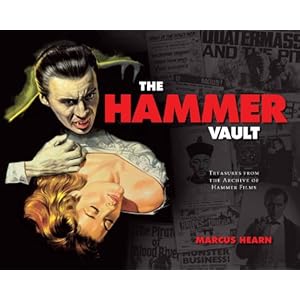
The Hammer Vault-- a MUST for Hammer fans

I just got my hands on The Hammer Vault. But first I have to ask:
Are you a Hammer fan? The funny thing is I find that generally if you understand the question, the answer is yes. Every week or so I post something about Hammer horror, and responses are divided between people saying I love Hammer! and What is Hammer?
Here's what I wrote in another blog entry:

In Horror, there's one world that holds together like that: a landscape slightly European and slightly British, slightly historical and modern, adaptable to many plots and characters and yet always recognizable. In Horror, there is the Hammerscape.
What is the Hammerscape? You have to see it to truly get it, but it is a cohesive horror universe reflected in curiously stagy and yet convincing sets, oddly lurid and sumptuous and yet stunningly classy colors (Ah, burgundy! Burgundy everywhere!), and not a single element that doesn't fit into the Hammer Ideal.
...
What made these films special? The conventional article on Hammer will suggest that the trick was to make Dracula and Frankenstein more "modern." They used color, after all. They explored sexual themes. All of this is true; it's a first-glance thesis that misses a lot. Hammer was not more "modern" than Universal- in fact, Hammer was quite the opposite. Hammer used modern tools to throw its films body and soul into a crushing and complicated love affair with antiquity. Universal's Frankenstein and Dracula came from a time when science had conquered the world and could conquer monsters, too. Hammer came from a time when we'd grown out of that ideal and found ourselves fearing the unseen once again.
So what am I going on about Hammer about this week? Oh, something outstanding: Marcus Hearn's THE HAMMER VAULT, a new book that collects all sorts of items-- lobby cards, memos, screenplay pages, magazine covers, publicity guidebooks, newspaper articles, and more-- related to every Hammer movie release from 1954's Quatermass Xperiment to next year's new Hammer release The Woman in Black with Daniel Radcliffe.

This is a very cool book for any horror fan because the articles and copy provide new information, covering the strategies for each of the films, internal politics and squabbles between creatives and censorship boards, and more. It's definitely a book I'll be pulling down to flip through over and over again.

Highly recommended for all Gothic horror fans and Hammer fans.


(Review copy received from Titan Books.)

Friday, December 30, 2011

Sherlock Holmes on Screen-- a New Guide to the Film History of Our Favorite Detective

I love Sherlock Holmes, but I'm not a Sherlock Holmes completist in the way that I am of, say, James Bond or Dracula. (And there's a geek continuum: I'm constantly reminded that there are many fans of those that are far to the left and right of me.) I do have a favorite Holmes-- Ian Richardson, largely because his BBC films were the ones I grew up on, whereas I largely missed the Jeremy Brett version that began the following year. The great thing about true geeks is we have geeky opinions; I remember a megafan of the Doors who could talk for days about what was wrong with the Oliver Stone movie, just as I could about Coppola's Dracula. Even when we're doing it we see the conundrum: we are spending more time on these works than the people who love them do. Sherlock Holmes has such fans.


So I love, love, love books like SHERLOCK HOLMES ON SCREEN, a guide to Sherlock Holmes adaptations of TV and movies written by Alan Barnes, who is a prize geek, opinionated and fussy and possessing a kind of love for even those works he hates. From the first Sherlock Holmes adaptation (1900's one-minute silent Sherlock Holmes Baffled) to the current dueling detectives of the BBC series Sherlock and the Guy Ritchie movie series, and everything in between. 
You can spend hours reading this book. I had no idea that Peter Cushing starred as Sherlock Holmes on TV  in the sixties, for instance. You can start to line up your own Sherlock viewing party.
I totally recommend Sherlock Holmes on Screen.


(Note-- I received this book for review from the great folks at Titan Books. Thanks fellas!)

Thursday, December 29, 2011

Word Processing: The Barbarian Savior!

The Slate Culture Gabfest this week spends some time talking about the history of writing on word processors (like Word, or like the blogger web tool I'm typing in right now), and the whole conversation (with helpful links on the Slate page) is well worth checking out.
What really captured my imagination was the lengthy discussion the podcast members had on the actual process of writing. How did anyone ever write a whole book longhand? Does writing with a word processor help you cut corners?
The Brother WP-75, which I drove carts. pushed wheelchairs and wrangled
unaccompanied minors all summer to buy. 
I've straddled the line. In early high school I wrote papers and stories longhand. When I was in high school I had a home computer to write papers on, and by the time I got to college I had actually worked all summer to save up for a Brother WP 75 word processor, which for the young was basically a printer with a keyboard and a single piece of software for writing documents. It was essentially a smart typewriter. I wrote my first book on a Mac, and my next several books on PCs using Word Perfect.
At the time there was a lot of talk about what word processing would do to writing. A lot of this talk came in the form of sour admonishments from other writers, so you heard all the same hand-wringing, but the biggest fear was this:
Writing on a word processor would make writers lazy, because a good writer types his pages, and then re-types them from the top, changing them along the way. Over and over again. And we like it. Word processing seduces you into sticking with something close to your first draft because it already looks pretty. There's a little bit of truth to this-- a first draft of anything really does look decent even if it reads terribly-- but it turns out for most of us that in fact we toss entire paragraphs all the time. Basically if you're a conscientious editor you'll be one whether you're typing, handwriting or using a computer.
And yet, and yet: I remember once I had to re-type about 40,000 words of a book I'd printed but could not retrieve the data from, and I really did enjoy re-drafting the sentences from the top as I went. But I wouldn't do it on purpose.
There was another fear, more obliquely spoken: that using a word processor, because it produced what to the naked eye appeared to be an acceptable manuscript, would allow too many unqualified people into the field of writing.
To this: first, f*** off, snobs. But second, reality tells us differently anyway; editors are pretty good at tossing bad writing after reading a single page. Heck, they toss almost all writing that way.
Check out the Slate Podcast and links!

RARE EXPORTS, A CHRISTMAS TALE episode

Our Holiday celebration continues with a brand new Castle Dracula Podcast: a discussion of RARE EXPORTS, A CHRISTMAS TALE.


I LOVED this movie.


(2010) Unusual Christmas story set in the frozen beauty of Finland, where local reindeer herders race against the clock to capture an ancient evil: Santa Claus. Single father Rauno (Jorma Tommila) and his young son, Pietari (Onni Tommila), are caught up in the chaos as international scientists dig for artifacts. What they find endangers the entire village.


Hear the new episode of the Castle Dracula Podcast:

Monday, December 19, 2011

Flesh and Blood (Monsterverse) by Bob Tinnell and Neil Vokes review

In 2004, VAN HELSING absolutely broke my heart. (You can hear a podcast review of that one from the Castle Dracula Podcast here.) Here was a big-budget Universal release of a monster mash the likes of which hadn't been seen since the 40s: Frankenstein, Dracula, the Wolf Man, all combatted by Van Helsing, the great vampire hunter of Dracula. The cast was the kind of thing that seemed to guarantee big box office, with Hugh Jackman-- freaking Wolverine-- and Kate Beckinsale in the leads. And... no. Word got out fast that the movie managed to be both over-complicated and simplistic, over-long and dull.

And worst of all, from my perspective: the movie had no heart. It had no idea why it was there. A story's got to have a reason to exist for people to want to see it. Star Trek is about wonder. Mission Impossible is about overcoming long odds with ridiculously detailed planning and teamwork. What was Van Helsing about? Not being scared, surely. So... wonder? What? To be able to answer the querstion, you'd have to have some awareness of the source material and be able to tell someone what made you fall in love with it and want to write about it. Another way to ask a creator "What is it about?" is: "Why did you want to write this?"

FLESH AND BLOOD is a new graphic novel (actually part 1 in a series) from writer Robert Tinnel and artist Neil Vokes that does what Van Helsing should have done: it shares its creator's love for an alternate world where Frankenstein, Dracula, and the Wolf Man all co-exist. It's a world they're in love with so much that every page is crammed with details that fans will recognize. Of course, where VAN HELSING was a missed opportunity for its creators to share the wonder of Universal Horror, FLESH AND BLOOD shares the wonder of a different universe, just through the veil from Universal: Hammer Horror.

If there were a perfect Hammer Movie that captured the look, feel, the horror and urgent eroticism of the strange universe that tied all the Hammer gothic horrors together, FLESH AND BLOOD may be as close to it as you will ever see.

The time is the mid-nineteenth century, when the seductive, deadly vampire named Carmilla has been put to death by a team of vampire hunters led by General Spiesldorf, who lost his daughter to Carmilla. The death of Carmilla sets off a chain reaction among humans and vampires alike. Carmilla's sister Ezebet goes to none other than Dracula, Lord of all Vampires, to solicit his aid in destroying the hunters. The hunters enlist the machiavellian Baron Frankenstein, here the spitting image of Peter Cushing, in developing an anti-vampire biological weapon. We meet a young Van Helsing, who like the young Lord Godalming in Dracula is the lover of a vampire, wounded to the quick and bound to learn the "rough work ahead" needed to rid the world of vampirism.

Bob Tinnell, the author, clearly knows his stuff-- he writes a sweeping story that's not only aware of his source material (Hammer movies) but even the source material of the source material. Vokes has a fantastic style for this work, too-- his art is expressive rather than realistic, so that vampires and men leap and swoop in perfect fantasy. His art perfectly with the world of Hammer, which was always a little dreamy and symbolic. I've been a huge Vokes fan ever since Blood of Dracula, a series I picked up in 1988, making him an even bigger Dracula geek than I am.

But even if you're not a Hammer Horror geek, any vampire and monster fan should read this. The Hammer world is just the palette Tinnell and Vokes use to paint a vivid dream of a world of monsters and men.

For those counting at home, by the way, Peter Cushing played General Spielsdorf, Van Helsing, and Baron Frankenstein in the movies. If this had been a movie made in the 70s, the trailer would have looked like a Blake Edwards comedy: "Starring... Peter Cushing! And Peter Cushing! And Peter Cushing!" In the comic, they do not look alike, which is just as well. Cushing's face is reserved for the Baron, and that seems fitting; it was Cushing's greatest role.

The book is brought to you by Kerry Gammill's Monsterverse line, which has been doing simply fantastic horror-geek work. Outstanding.

Wednesday, December 14, 2011

Gremlins: The Bad Chimney Episode

It's Christmas time, and that means strange green creatures swarming your tiny American town. Yes! The Gremlins episode is up!


Listen in and welcome to the second episode of the Castle Dracula Podcast Holiday Season.


In this episode we discuss Gremlins:


Gremlins (1984)-- a film about a young man who receives a strange creature—called a Mogwai—as a pet, which then spawns other creatures who transform into small, destructive, evil monsters. It all takes place in a lovely little town at Christmastime, and it’s chock-full of references to classic movies and even folklore, as you might expect from a film produced (as it is) by Steven Spielberg.


Hear the new episode of the Castle Dracula Podcast:
or here:

Wednesday, December 7, 2011

Alex Van Helsing 3 Revisions and Style Sheet

So this week I'm doing another rough of edits on Alex Van Helsing: The Triumph of Death, which comes out in Summer 2012.

At this point the kinds of changes I'm making are in a Word document with "tracked changes" from the editor and copyeditor. There are countless tiny choices and changes, and we leave comments for one another in the margins. Is this kind of vampire capitalized? Can we get a different word here to avoid an echo from a paragraph above, or was that on purpose?

One of my favorite aspects of this is a Style Sheet that HarperCollins provides, which is like a field guide to the world of Alex Van Helsing. Not only does it include a synopsis of each of the books, but it has a nifty Alex Van Helsing Glossary:


Neat, huh?

Monday, December 5, 2011

The Monster Squad: The Thumbs Up From Limbo Episode is up!

Listen in and welcome to the Castle Dracula Podcast Holiday Season.


In this episode we discuss The Monster Squad


Somewhere in the 80s, a ragtag band of lovable loser kids must save the world from the machinations of Dracula, Frankenstein's Monster, The Wolf Man and the Creature. Definitely a movie for the young and monster fans who are young at heart.


Hear us:
or here:

Thursday, November 17, 2011

An Alex Van Helsing Christmas Promotion: Order Both Books and Get a TOP SECRET Preview of Book 3

Just this week I got a letter from a student in Denver who published a review of Alex Van Helsing: Voice of the Undead in the Denver Post. I was so thankful (and impressed-- I wasn't publishing reviews in the paper in middle school!) that I sent her a bookmark. It was wrapped in scratch paper that just happened to be a page from an editing draft of Alex Van Helsing #3: The Triumph of Death. The student wrote back that she loved the sneak preview as much as the bookmark.

And that got me thinking.

It's Thanksgiving. It's Christmas shopping time. So here's my commitment to you.

Want to get the action-and-vampire-loving reader in your life a great set gift? Know a boy or girl who loves spies, motorcycles, helicopters, and monsters, not necessarily in  that order?

Order them the first two books in the Alex Van Helsing series.

Anyone who orders or purchases Alex Van Helsing: Vampire Rising and Alex Van Helsing: Voice of the Undead together between now and December 25, 2011 will get an email with an exclusive sneak peek at July 2012's Alex Van Helsing: The Triumph of Death. 


I'll give you access to a whole scene, not available anywhere else until well into next year.

Here's how:
Who: You.
When: now until 12:01 December 26, 2012
What: Order or purchase, online or off,  both Alex Van Helsing: Vampire Rising and Alex Van Helsing: Voice of the Undead.

How:
  • Email me proof at jasonhendersontx@gmail.com . 
  • Use the Subject Line: TOP SECRET PROMOTION
  • What's proof? Forward me a receipt (be sure to clip out anything you don't want to share) or if you have a paper receipt, just take a phone pic of it and send it. 
  • I'll email you back your top secret preview of Book 3, Alex Van Helsing: The Triumph of Death. This is material that no one outside of my house and my publisher has seen. I leave it to YOU to guard it with your life.
If you or anyone you know would have their world turned upside down by our favorite motorcycle-riding, WaveRunner-stealing, vampire-killing high school superspy, then now is your chance for a completely rare gift.

Pass it on. 


Thursday, November 10, 2011

Listen to Castle Dracula Podcast now on Stitcher!

This is very exciting news. I've actually been a fan of Stitcher, the best podcast-listening mobile app I've discovered yet, for some time. I've gotten to the point where I'm as likely to listen to my podcasts via Stitcher as often if not more often than I do via iTunes.  So I totally recommend it. But now CASTLE DRACULA PODCAST has been added to Stitcher. You can listen to the latest episode plus past episodes.
Look for a new episode very soon!

How do you get Stitcher? Go to your mobile app store, or go to Stitcher and click the Download tool.


Our show is now on Stitcher!


Listen to us on your iPhone, Android Phone, BlackBerry and WebOS phones..
Stitcher is Smart Radio for Your phone. Find it in your app store or at stitcher.com


Stitcher SmartRadio- The Smarter Way to listen to radio.