Jason Henderson's FB Feed

Showing posts with label vampires. Show all posts

Tuesday, September 14, 2010

Encyclopedia of Vampire Mythology an incredible resource for vampire freaks

For the past week I've been reading Theresa Bane's new Encyclopedia of Vampire Mythology, a book so deeply researched and thorough that I've never seen anything quite like it. I've read a fair number of books on vampires and vampire literature; my favorite is J. Gordon Melton's The Vampire Book. That excellent work covers the whole range of vampires with an emphasis on pop culture, so one finds articles on a whole potpourri of vamp material: nearly 1000 pages long, Melton provides articles on Anne Rice, Blade, Chelsea Quinn Yarbro, Lord Byron, Dark Shadows, even the short-lived Dell Comics superhero Dracula. If it's vampire and it appeared before the latest edition, it's in there.

The Encyclopedia of Vampire Mythology book is a different animal, a thorough and seemingly exhaustive recording of every vampire myth Bane could find. This is a book for people who want to absorb the breadth and possibilities of the vampire myth. I can't begin to convey how impressive this is because it clearly required years of painstaking research, capturing myths from Malaysia, Japan, Eastern Europe, pre-Colonial America, the Jewish Apocrypha, wherever there appear to have been people.

Bane tells us that the Indian Brahmaparush is a vampire that detaches its head and flies around as a head, with entrails hanging down, and you can kill it by drying out the hidden skin with salt.  Variations of this myth appear (in other entries) as Malaysian Penangglan, the Thai Phii Krasue, the Indonesian Pontianak, and have flying-head cousins among the Chilean Chonchon (though that one has big wing-ears, and no entrails,) and the Iroquois generically named "Flying Heads." There are way more than this, because flying heads get around.

Disclosure: I was ready for the flying heads because I used them once in a Ronnie Van Helsing story.

Another big deal is cats: the German Dockele appears as a cat, and so do the Greek Draskylo and, among many, many others, the Hungarian Farkaskoldus (this one is the unlucky soul killed by a werewolf: who knew? Also the Farkaskoldus can turn into a goat.) The same themes appear again and again. Live a sinful life, come back as a vampire and haunt your family, so, don't do that. Also men should beware of wanton women, the world over, apparently.

My favorite vampire? Hard to say, because there's so many vampires, densely packed into the seemingly slim 200 pages, but I love the pitiful German Dodelecker, who is so weak that he rises from his grave only with great effort, and then wanders around, unable to attack anyone. Eventually, hungry and unsuccessful, it falls down and dies. I also like the Japanese Kappa, a polite, sumo-wrestling sort of turtle vampire that carries water in an indentation in its head, and if you bow and the turtle bows back, the water spills out, rendering the Kappa unconscious. Aside from attacking people from time to time, the Kappa steals a lot of melons and cucumbers.

Here's a typical (and shorter than most) entry, chosen at random.

Preta (Par- EE- ta)
The preta (“morbid”) is a vampiric spirit from India. It appears as a fresh corpse whose stomach
is bloated and large but its mouth has shriveled up, leaving only a small opening. Walking the
earth lost and hungry for human blood, the Buddhist faith sees the preta’s condition as a fitting
punishment for a person who had too many desires in life.
Source: Crooke, Introduction to the Popular Religion, 153; DaniƩlou, Myths and Gods of India, 27, 213, 301, 311; Turner, Dictionary of Ancient Deities, 184

This is a book that digs into folklore on vampires and delivers a fantastic resource for writers especially, looking for inspiration. For true vampire freaks I can't recommend it enough.

Theresa Bane has a blog herself, so you should check that out as well.

Sunday, March 28, 2010

The Clarity of Old Vampire Movies

I watch a lot of vampire movies, and they stack into genres that line up almost perfectly with their era. 30s and 40s vampire movies-- and I'm thinking of Dracula '31 and movies like House of Dracula-- tend to be earnest nightmares that have a sense of innocence about them-- at least those coming from Universal. These movies could be watched by children today with a few exceptions. Everything is clear and unambiguous. Dracula is a monster, and if he offers any temptation to the dark side, it's an understated temptation.

In the Gothic Era of the 50s through the early 70s, from Horror of Dracula to Vampire Circus, you get a more complicated moral universe-- here, the vampires are enticing and the get more beautiful; Christopher Lee is attractive and the Brides tend to be pretty hot. The idea here is that evil is attractive, but the movies still remain firm in the notion that the vampires are evil. This gets really complicated in movies like Vampire Lovers, where evil must be punished but sure seems a lot more rewarding than everyday morality.

Queen of the Damned (Widescreen Edition)In the modern era, that clarity is gone-- in movies like Interview with the Vampire, Queen of the Damned and certainly Twilight, vampires are either an alternative lifestyle or an alternative race existing symbiotically with humans. 
I think all of these theories have their place. Sometimes I want to watch the child-like fantasies of the Universal horrors. But I find the middle period the most fascinating, because there's a genuine conflict there: the movies hold out a universe where the forbidden is genuinely enticing-- but to do the thing that is most enticing, to dally with vampires, is to tempt the wrath of God. In the modern movies, the wrath of God is no longer a concern. There is only loneliness, and with any luck, love. There is no more temptation because there is no more forbidden.

What seems strange to me is that the belief systems of the audience can't possibly be the reason for this shift. The moral universe of a movie about magical beings has nothing really to do with the moral universe of the audience-- that is, it doesn't matter if you or I believe in Heaven or Hell to follow and get involved in a movie that believes in Heaven and Hell. But the threatened loss of a character's soul makes for much greater conflict. More likely it's a cycle:  we are in the era of vampire romance, and the concern for the characters is a concern for their happiness and not their salvation.

All of which is funny when you consider what I write are adventure books where the vampires are on the evil side. So there's no temptation there to begin with (not in the first couple of books.) But I think if there were, I'd make it a dreadful worry.

Wednesday, November 25, 2009

Polidori's Vampyre and Byron's Augustus Darvell


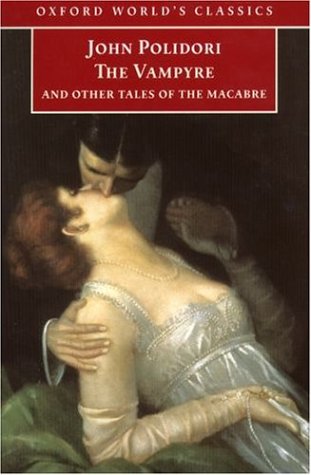
Over the past few days I was on vacation and read John Polidori's The Vampyre alongside Lord Byron's Augustus Darvell (AKA "A Fragment"), which are both reprinted in a recent Oxford collection. This turned out to be a fascinating little assignment for any vampire fan.

The importance of Polidori's Vampyre has been documented well enough; the story, first published in 1819, was an outgrowth of the 1816 Villa Diodati party at which Byron, inspired by the German horror anthology Fantasmagoriana, challenged his guests to each write a scary story.

Technically only two complete tales resulted from the challenge: Mary Shelley's Frankenstein, published in 1818, and Polidori's 1819 Vampyre. Polidori's story was the first modern vampire tale, taking the folkloric concept of the ghoulish, decrepit peasant wraith and transforming the vampire into a satire of upper-class devilishness. The villain, Lord Ruthven, is a thinly veiled parody of Lord Byron, Polidori's former employer and friend. But when Vampyre first appeared, it was credited to Byron, a fact that appalled both Byron and the actual author.

Polidori felt robbed of his due credit and Byron-- the single most famous author in England at the time-- felt besmirched, not by the portrait of him in the story, but by any writing he didn't perform. Further, Byron hinted at plagiarism: apparently Byron had told a story at the party that had come out very similarly to Polidori's Vampyre. This idea-- that Polidori had in fact stolen the story-- moved Polidori to write in a note in his 1819 novel Ernestus Berchtold that in fact Vampyre was suggested by a kernel of an idea from Byron:
The tale which lately appeared, and to which his lordship's name was wrongfully attached, was founded upon the ground- work upon which this fragment was to have been continued. Two friends were to travel from England into Greece; while there, one of them should die, but before his death, should obtain from his friend an oath of secrecy with regard to his decease. Some short time after, the remaining traveller, returning to his native country, should be startled at perceiving his former companion moving about in society, and should be horrified at finding that he made love to his former friend's sister. Upon this foundation I built the Vampyre, at the request of a lady, who denied the possibility of such ground- work forming the outline of a tale which should bear the slightest appearance of probability. In the course of three mornings I produced that tale, and left it with her.


Byron, meanwhile, insisted that his publisher release The Fragment that appeared at the end of Mazeppa. That story, though unfinished, hews closely to Byron's kernel.

Here is what I can report on reading them both together:

They are very different stories. Though Polidori clearly took Byron's idea as inspiration, the Polidori story is essentially a satire of Byron overall, and has a wry, cynical, almost modern voice.
[Aubrey] hinted to his guardians, that it was time for him to perform the tour, which for many generations has been thought necessary to enable the young to take some rapid steps in the career of vice towards putting themselves upon an equality with the aged, and not allowing them to appear as if fallen from the skies, whenever scandalous intrigues are mentioned as the subjects of pleasantry or of praise, according to the degree of skill shewn in carrying them on.

His description of Ruthven/Byron is withering: Ruthven is handsome, rakish, and demonically cruel, giving drink to drunks and money to gamblers, but hastening the destitution of the desperate and despoiling the pure. He is capable of great kindness, and nurses Aubrey back to health, before turning cruel again. And it turns out he's a literal vampire. The dramatic moment of the character's death in Greece-- shot by bandits in an action scene-- is only used to set up the vampire's return.

Byron's tale is not a complete story, but in general it is clearly a poetic work of heavy symbolism and high language. The central focus is still two men, one a Byronic character-- rich, dangerous-- but where Polidori's version is only begrudgingly sympathetic, Byron's is rather self-impressed:

I heard much both of his past and present life; and, although in these accounts there were many and irreconcilable contradictions, I could still gather from the whole that he was a being of no common order, and one who, whatever pains he might take to avoid remark, would still be remarkable.


The death of the remarkable Augutus is more like a piece of folklore-- he makes the trip to Greece specifically in order to die and begin a year-long rebirth, and he presses the narrator to complete this revival by throwing a ring into a river.

So: Byron's is a lovely enough-- but abandoned-- story; prose never held his interest. Polidori's story is funny if melodramatic, and very modern, especially in that it gave us the modern, Byronic vampire. One thing's for sure: without Polidori and Byron we would have no Byronic (wan, sad, sexy) vampire at all, no Dracula, no Carmilla.

Would love to hear anyone's comments!


Thursday, October 22, 2009

Halloween Treat Links: Watch Black Sunday Free Online!


Black Sunday -- creepy, mysterious, melodramatic-- is a vampire movie so grand that it once determined where I wanted to live.

It's true. Back when I got out of law school, my wife and I drove across the country to Austin, Texas, to spend the Summer and study for the Bar Exam. It so happened that for years I had been reading about Black Sunday, from Mario Bava. "Not the Blimp Movie," I had to tell people, because there was a movie called Black Sunday about terrorists with a blimp, or something, and I knew this because I was always looking for this movie, at every video store, in every city, from New York to DC to-- well, to Austin. No one had Bava's Black Sunday.

So in Austin I wandered-- the first evening we were there-- into Vulcan Video. "Do you have Black Sunday?" I asked, adding, "Not the blimp movie."

The guy at the counter said: Do you want the American or the European cut?

We stayed in Austin for ten years.

That whole story? Antiquated, because now you can watch it free, online.


Here's the trailer:


You can watch it online at Hulu.