Jason Henderson's FB Feed

Showing posts with label writing. Show all posts

Friday, June 14, 2013

Don't believe you can't: Write in as many media as you want

I used Grammarly to grammar check this post, because life is too short to look for split infinitives with your bare eyes.

Here’s something I hear a lot: a writer will say, “novelists don’t make good screenwriters,” or “screenwriters shouldn't try to write games,” or “comic book writers shouldn't try to write novels.”
We know these sentences are nonsense (I could choose a coarser label) because when someone who does something for a living offers you advice that happens to discourage you from joining their profession, they probably have their own and not your interests at heart. And that might not be completely conscious; a lot of people don’t realize the philosophies they hold dearest are heartily buttressed by convenience. So if you hear someone say that, nod and smile and whatever it is you want to write.

Because here’s why it’s really nonsense: different kinds of writing are different, no doubt about it. But a good writer can excel at more than one kind of writing. You might have the medium you’re best in, but if you’re a writer, you’re probably a few steps ahead in another medium than someone who has no felicity for language.

The rest is just details, rhythms, styles.   I actually thrill to the difference-- a screenplay is not a novel is not a game script.

This week I worked on a script for IDW comics, the first issue of a miniseries about a popular TV character.  Comic book scripts mostly offer challenges about space and pace: a comic book script usually runs exactly 20 or 22 pages, usually 5-7 scenes. I usually outline in Word or Excel, write comic scripts using Final Draft, the screenwriting tool, then deliver the script to the editor in Word, where we do the editing.  Another comic I wrote with Tony Salvaggio, Clockwerx from Humanoids, is coming out in hardback, and I wrote several interview responses.


  • Medium: Comic book script
  • Format: Feature Screenplay Derivative
  • Tools: Final Draft, Excel, Word


Meanwhile, I worked on a novel. Genre novels like the modern horror book I’m writing usually run 300-400 pages long. There’s no set number of chapters or pages—unlike in comics, you have to hew closer to a sense of how the story is going and when you need to turn. I outline in Excel and write in Word.


  • Medium: Prose Novel
  • Format: Long form prose
  • Tools: Word, Excel


I also host a podcast, the Castle Dracula Horror Movie Podcast. For that,  I have to write an introductory script each week and prepare my questions. I intro the show; the rest is a panel-type discussion.

  • Medium: Podcast Script
  • Format: Radio Script
  • Tools: Word


At the same time, Teenage Mutant Ninja Turtles: Out of the Shadows, which I wrote the game screenplay for, got announced as part of the Xbox Live Summer of Arcade 2013. Game scripts are a different beast—I wrote those partly in Final Draft and partly in Excel.

  • Medium: Game Script
  • Format: Feature Screenplay Derivative for cutscenes, Database for incidental dialogue
  • Tools: Final Draft, Word, Excel


I’m going to spend some time blogging on each. They’re all different and they all offer challenges. But I wouldn’t have it any other way, and you shouldn’t either. If you write, you work with words. The rest is skill, and if you’re still alive, there’s wondrous time to learn.

Tuesday, September 20, 2011

Jody Hedlund on Missing Your Own Writing Faults

Check out Jody Hedlund's post today on something that I think haunts all writers: the ability to miss your own mistakes, faults and tendencies.
Instead, most of us polish up our work until we think it shines with brilliant glory. We labour over it and try to get every word perfect. Sure, our fingers might tremble with anxiety when we finally hit send, but let’s admit it: we usually think our work is pretty darn good. Otherwise we probably wouldn’t put it out there.

Yet . . . the large majority of manuscripts that agents and editors see just aren’t ready for publication. And in the contest I recently judged, most of the entries weren’t ready for publication either. They had potential but still needed more time and growth.

Why do we struggle to know our skill levels? When we’re just beginning, why do we often think we’re better than we really are? Why are most of us blind to our own faults?
Be sure and chime in at her blog if you have some ideas beyond those that Jody lays out.

For my part I think the biggest blinder to faults in my own writing is wilful disbelief. I know what line is supposed to sound like! See, the alliteration is cool if you read it like this! As if I could go to everyone's house and read them the sections they might need help with.

The thing that I have to remember as a novelist is that my prose is not a script that I will read on the radio. It's a script that the reader needs to be able to perform in their own heads, and if the direction ain't on the page, it ain't on the stage.
It turns out I can deny that over and over, I can be blind to it, but it matters. You don't just have to read your work aloud-- or at least aloud in your head-- you need to forget how it goes and then read it aloud.

Great post.

Wednesday, April 27, 2011

Time Period Settings

Agent Mary Kole has a great post today on choosing your time period in YA fiction, and it's well worth reading. There's so much to like in it, especially Kole's urging that we not put books into the past just because we want to "write what we know" to the point of alienating the reader. This hits close to home, because don't we all want to spend some time waxing rhapsodic about whatever time period we grew up in? But unless a story has a darn good reason for taking place in the 80s, my high school story needs to happen today.

She also spends some time on the need to reference current technology, no matter how much it messes up your plot:
Here’s the reality: Kids today are attached to their cell phones and their computers. There are fewer and fewer places on this planet where we are cut off from communication, achieving that total isolation that lets evil characters and conspiracies and mysterious plot twists work their machinations. But technology and connectedness are, for better or worse, how kids relate to the world today. While this is at odds with a lot of good and suspenseful fiction, writers are going to have to adapt, especially in the future, as information becomes more and more accessible. You have to figure out your own solutions to cutting characters off from information, because in 20 years, all of our mystery novels just can’t be set in the 80s to take the shortcut around it. That’s not realistic.
What Kole is referring to here is something all writers have to deal with: a lot of thrillers of past decades work they way they do because the main characters don't have access to Google, much less their cell phones. Writers have to take these new capabilities into account; otherwise the reader will constantly be asking, "wait, why didn't she just look that up?"

Check it out.

Monday, January 24, 2011

I don't believe in writer's block; I do believe in school visits

It's true!

This past Friday I finished one of the best weeks of the past year because I met with five different groups of students in the course of an evening and a day. On Thursday I went to Irving, Texas to hang out with the students at Java Makes Me Jump, a regular event held by the Irving ISD at the Barnes and Noble. That was a fantastic time-- I presented on writing manga and how it compared to writing books and American comics, and of course showed off the ARC for Alex Van Helsing: Voice of the Undead.

Then Friday I presented to sixth and seventh graders in Frisco, Texas at Clark and Scoggins Middle Schools. My school presentation is a powerpoint that goes into the whole process of launching a YA series, from the initial idea and pitch through the finished product. I use lots of art and fun examples like showing early versions of the Alex Van Helsing: Vampire Rising cover compared with the final. We usually round it out with Q&A, and I encourage the students to, if they can't think of anything else, just try to stump me with vampire questions.

They do try. Some of thge questions really are tough: "Which came first, zombies or vampires?" (Answer: it all depends.)

And one of the questions, from a young writer, was how to deal with writer's block, and in particular she meant, what do you do when you're halfway through your project and suddenly feel stuck, like you can't move on. What do you do, she implored. WHAT DO YOU DO?

Great question. Actually what you do here is deviate from your plan, most likely. Most likely you've stopped because you're bored and you need to be excited again. So deviate. Put a character you're tired of in a coma. Have the bad guys catch wind of the hero's plan ahead of schedule and drop a house on them. Anything. Deviate and move on.

I don't believe in writer's block except that I believe it is a manifestation of boredom, of being disappointed in what you chose. So choose differently, and get the dang first draft done.

Questions?

Wednesday, January 12, 2011

Writing is a lot of things, but mostly it is hard

Holy Mackerel! I haven't updated my blog since January 3. See what happens when you're knee-deep in the rough draft of a book? I also need a haircut. And my family may well be forgetting what I look like.

Today I was reading Neil Gaiman's Pep Talk for Novel Writers, written for the people participate in NaNoWriMo, National Novel Writing or Writers or Something that Makes this Acronym or Whatever It Is Work. NaNoWriMo, which I've never tried, asks you to kick out a 50,000 word novel in 30 days. You know what would come after that? Month two, revisions, NaNoWriMoBetta. My hat's off to those guys. I can't re-create Neil Gaiman's wise words here because Kenny G doesn't try to follow Charlie Parker. But what Gaiman says is, writing is hard. It's one of my favorite things in the world, and I need it with a burning, addictive need, but it's never easy.

Right now I'm writing the rough draft of Alex Van Helsing Book 3. No title yet, though in my mind so far it's called The Triumph of Death.

I've told you I work off an outline, right? Here's the one I'm using currently:

I actually do this. I have an outline in Excel, and as I complete certain chapters, I turn the yellow boxes green. Yeah, I know.
What happens when I make a major change, though, and it throws the whole outline off?
Yeah, what about that? It does happen. It happened this week. I'm about 40,000 words into this book and suddenly realized a key moment in the outline just wasn't working. What then? In my case, I take out my notepad and start scrawling. Maybe the characters don't go this extra place. Maybe we eliminate this subplot entirely. Ohmygod what if this whole subplot is a symptom of a larger problem and wait we needed to get that conversation in and wait there's too much talking and suddenly you're a guy building a tower of china cups on a tray you're actually holding, while you attempt to type a novel. Stephen King writes about these moments well in his On Writing: "OhmygodI'mlosingmybook!"
One word after the other. One sentence after the other. Outline, revise, write, write, more words, a thousand today, that's my goal, though my day is night, since I work by day.
It's work, hard work, and in the end it's lonely work because you can't really download your whole draft into someone else's head. You desperately worry that you're screwing it up, but you're on one brick in the wall, and the wall has sixty thousand bricks.
With any luck I'll be done with a rough draft in a couple of weeks, and then it's revise revise, revise. Fix the notes I've put in for myself. Eliminate characters, sometimes eliminate whole plots. Ditch the stuff you know is half bothering you and you don't want to admit it, but it will bother the reader.
And that's before it even goes to a publisher.
I really do love this process. This is the party I came for.

Wednesday, December 29, 2010

Joelle Anthony's 25 YA Cliches List

Joelle Anthony has re-posted her excellent list of the 25 Things Most Overused in Middle Grade and YA Fiction.

Some highlights:

#25 – Vegetarian teens with unsympathetic meat-eating parents

#24 – Shy or withdrawn characters that take refuge in the school’s art room/ compassionate art teachers

Joelle Anthony
#23 – A token black friend among a group of white friends – usually it’s a girl, and she’s always gorgeous

#22 – A tiny scar through the eyebrow, sometimes accompanied by an embarrassing story

-- and so on. I think it's important to note that you're free to use any of these cliches if we we feel you must. But knowing it's a cliche at least gives you two things-- a chance to be sure of the choice and put some spin on it, and a chance to toss the cliche and try something else.

By the way, the #2 item-- best friends with red hair? Guilty.

Monday, November 29, 2010

So you want? (#pubtips)

You may have seen the video called "So You Want to Write a Novel" that has been making the rounds. It is funny-- I've pasted it below if you haven't seen it. And it's easy to laugh at this guy, the imaginary wannabe writer with his nonsensical requests (Do you want to be a ghostwriter? I'm not a very good speller.) To me what's most telling about this person is his notion that writing is easy. It's easy to laugh at this.

And yet, and yet. I worry about this stuff, because I see a lot on the web that sort of divides the reasonable writer with reasonable goals from the idiots, and whattayaknow, the writer making the post is always on the side of reasonable. I'd like to throw out a few of my own pointers for writers:

You don't have to tamp down your expectations. I hear this all the time: don't expect to be a bestseller. Don't expect to make a lot of money. Don't expect that you'll get any reward from writing other than the satisfaction of a job well done. Actually, I'd back off the expectation of satisfaction as well.

Jeez, guys-- what kind of business people are we if we blithely expect to fail? This is terrible advice. I get that we want to keep writers from having unrealistic expectations, but I guarantee you that expecting failure guarantees it. Expecting no money guarantees it. Expecting no readers guarantees it.

Write your ass off. Finish the work. Make it awesome. Sell it. Do as much marketing as you can, as though you were opening a restaurant and you'll starve if it doesn't go. Expect big things. Don't be a jerk, and keep writing your ass off.

I've been writing professionally for about 17 years. In every single project I simultaneously carry two thoughts: this is genius and this is garbage. The first is what keeps you going, because guess what, no one else will be your advocate. No one else has to. Even your agent has other clients. You-- only you-- are the one to believe in you. You have to believe in you more than anyone else. The second thought (this is garbage) keeps you working your ass off.

Funny video, though.

Friday, November 12, 2010

Outstanding self-editing tips from Aimee Salter

I love reading about writing-- at least the nuts-and-bolts stuff on writing, on the craft, the trade, the way we choose and use words and why who buys what. All that.

The soft-focus stuff about why we write somehow escapes me; I feel better when I write and worse when I don't, and the rest is blather. But I love practical advice that improves my actual writing, so I read a lot of books and articles about the craft. I've mentioned Stephen King's On Writing, but of course I also love Card's How to Write Fantasy & Science Fiction, Syd Field's Four Screenplays, Dibell's Plot, and too many more.

A lot of these books even contradict one another: write with an outline, or just go? Bounce ideas off friends or work in secrecy? Edit now or write something else first? Of course they contradict one another. This is an art. You get better by studying and practicing, but there is no perfect.

I just found a blog that I absolutely love from Aimee Salter that is full of practical, useful, hammer-and-nail writing advice. Salter specializes in advice that helps you eyeball your own work for obvious pitfalls:

Seek and Destroy "was"

I've left this one until last because when you go through your manuscript searching for 'was', prepare to be there for a while. And each replace will be a little more involved. In most cases you won't be able to simply delete 'was' because you'll have to change the tense of words around it. But the seemingly endless task is worth it.

In most cases, the change is simple: "I was leaning on the windowsill." becomes "I leaned on the windowsill." Or, "I was faced by half a dozen upper-class snobs." becomes "I faced half a dozen upper-class snobs."

See the difference?

Now of course, you could read that and say, but my sentence really needs a "was", and maybe it does. But these are tools to help get rid of the rest, and set those sentences apart.

I have been writing for a long time, and I feel that only in the past few years have I gotten my legs under me. Exposure to tools like Ms. Salter teaches would probably have helped me, if I had sought them out and had the sense to use them. Check out her Self-Editing Tips and Tricks blog!

Monday, September 13, 2010

Final Edits on Alex Van Helsing: Voice of the Undead

That image to the left is my task this week, the final rounds of edits on Alex Van Helsing: Voice of the Undead, the second book in the Alex series.
This time what I have here are "galley proofs," typeset pages that are almost exactly the book as it will appear next in ARCs, the bound galleys that go out early to reviewers. Voice of the Undead doesn't come out until July of 2011, so likely the ARC won't even come for many months. But now is the time to make last edits. In this case, I'm going through the printout of the book-- some pages are stapled together, where editors have made minor changes and re-stapled in order to maintain pagination-- and making notes in pencil.
 It's very strange to be at this point with Voice of the Undead. Reading through it this week was my first time looking at it in a couple of months, and actually I think it reads better than Book 1. For one thing, it benefits from the fact that all the characters are in place, and now we can follow them around without having to re-introduce anyone.
In Voice of the Undead, Alex faces off against a very old vampire who has the ability to bend people to his will. It's an opportunity to explore Alex's own resourcefulness and the extent of Alex's "static," the ability he has to sense vampires. But along the way, we get more character interplay, and even more-- slightly more-- romance.
I think perhaps the strangest aspect of writing these books for publication with HarperTeen is that as writers we tend to be very protective of every idea we have. We want our first version to be the best, as if somehow not only our ego but the actual value of the book itself is contained in the feverish first draft. But it isn't so-- I've been writing for a fair amount of time, but I've learned recently to slow down, to re-work. Your ego does not exist in the first draft. If there must be ego, it exists in the final product. The final product will have your name on it and be bought by people around the world. Moreover, the final product will be the work of many people beyond the writer, and all of them are taking risks. You owe them a book they can show to their moms. The process of building a book for publication is the process of embracing the fact that you are not alone, whether you like it or now.

Thursday, June 17, 2010

Somewhere a Dog Barked

This Slate article is one of the most awesome I have ever read: Somewhere a Dog Barked: Pick up just about any novel and you'll find a throwaway reference to a dog, barking in the distance.

I don't think I've seen anyone pick apart a go-to cliche this well, ever. The writer reports correctly:
Most authors, however, employ the trope as a narrative rest stop, an innocuous way to fill space and time; since the bark is hollow, a reader can read anything into it, or nothing at all. 

 I think that's true, and though I've read a lot about the use of cliches that draw a lot of attention to themselves (like opening a book with a dream, a daring trick nowadays), I loved that this article spent time on cliches that are almost parts of speech.

Think of it: let's say you're writing a book that will be 300 pages long. Speaking from experience, my upper limit is about 8-10 pages a day, about 2000 words. Sometimes I can really stretch, but generally not; 2000 words is about as good as it gets. 10 pages in 3 hours, meaning one page is taking about twenty minutes on average. One page. As you write your way down, you're working in prose, following the characters, telling the tiny sliver of the story that is this one page. The page is made up of words, phrases, all the crazy tools you use. At this speed it can even be hard to remember what you did multiple pages-- hours-- ago.

And I, like a lot of writers, have a bad habit of leaning on stock phrases to get me from one thought to the next. Most of I catch time you catch them on the re-write, but they're just noise, usually ways of breaking up a thought.

"That's interesting." Bond tilted his head. "That wasn't there before."
What on earth is meant by "tilted his head?" I suppose it means the character is thinking and uses a physical movement to pantomime thinking. But really it's just rhythm. Same thing with the barking dog in the distance. See also arched an eyebrow. And smiled slightly. People in my books also fiddle with props a lot in dialog scenes. Otherwise the dialog would read like a play. All of this is okay as long as it doesn't get irritating, and then it's not anymore.

There are a thousand ways to race to the bottom of the page, and the rough draft will be filled with some awful ones. We have to accept this as writers or else we would not reach the next page.

Monday, April 26, 2010

Literary Agent Advice & What are Rules For?

The Guide to Literary Agents posted a column of Chapter 1 mistakes most lit agents would prefer writers avoid. As a learner, I think this is all pretty useful advice. A lot of our favorites turn up, such as the agent who shares:

"I dislike opening scenes that you think are real (I rep adult genre fiction), then the protagonist wakes up. It makes me feel cheated.  And so many writers use this hackneyed device. I dislike lengthy paragraphs of world building and scene setting up front.  I usually crave action close to the beginning of the book (and so do readers)."
        - Laurie McLean, Larsen/Pomada Literary Agents


That absolutely has to be true. I can tell this as a reader-- not opening with a dream sequence seems like a good rule. Actually, that's the problem with these lists. They're all good and the advice is all useful. But somehow I wish they all came with a caveat like "everything here is a rule of thumb."


Michelle Brower of Folio Literary Management (like Laurie McLean above) nicely couches her own advice in what has to be the best possible formulation, that this is about how she reacts: "I do in fact hate it when someone wakes up from a dream in Chapter 1, and I dislike an overly long prologue.  The worst thing that you can do is let that crucial chapter be boring - that’s the chapter that has to grab my interest!" 


You know what that rule is good for? It gives you some decent advice about opening chapters, but also tells you what Michelle Brower doesn't like, which is probably more important if you're showing something to her. 

The prologue question haunts me, though I'm not sure why. I don't actually use prologues myself, or haven't yet in a novel. And everyone can sort of nod and roll their eyes at poor examples of prologues. And yet this is one of the most well-broken rules in books. Harry Potter 1 opens with a prologue; I wouldn't cut it for the world. Every Alex Rider novel opens with the bad guys doing something somewhere to set up the plot. Almost every one (if not every one) of Clive Cussler's Dirk Pitt(R) novels opens with a historical prologue that presents the particular Maltese Falcon that Pitt will be chasing for this adventure. I can just imagine someone saying, "You know, Clive, how about we open with Pitt in an action scene, and we sprinkle in the stuff about the shipwreck later." I guess we could. I would. But Cussler doesn't, and that serves him well.


All of the advice you read is good. If you take your own work and run it through the advice you read, you'll likely catch a lot of issues. 

But here's the emotional kernel at the heart of these lists that I think needs to be said. These lists of rules and advice are not a magical formula that will protect your work. Following all the rules will not stave away rejection any more than it will stave away boredom. These are not completely unrelated-- a writer who seems to know no rules of writing whatever very likely will product poor work. But following these conventions-- and that's all they are; there's no actual God of No Prologues-- will still not guarantee that our work is good. There is no protection against needing to do more work, or needing to abandon the project entirely. Don't Open with a Dream Sequence is no talisman against rejection.

I read a lot of writing on writing and prefer the nuts and bolts kind; my favorite is Stephen King's On Writing, and I love The Writer's Journey. For grammar I still prefer The Elements of Style. But the advice we read that is more about selling our work is usually more a report of what the agent or editor is tired of, and I tend to find reading it all makes me weary because I can hear their weariness. Your best talisman against that is work that makes them wake up, and the rest is noise.


Tuesday, April 13, 2010

Smash

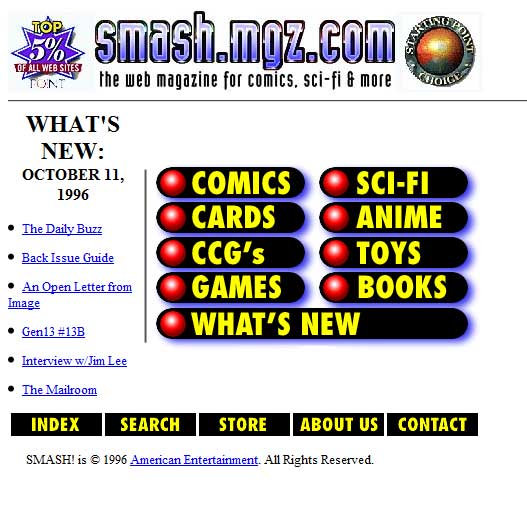
In September of 1996, I was married, unemployed, living in Austin and running out of options. I'd graduated from law school, but I wasn't going to be a lawyer. That much was clear: I'd spent most of law school writing fantasy and franchise novels and now, back in Texas, I wasn't really likely to work for a large firm.

But there wasn't much else. By my birthday in early September, I'd been in Austin for a Summer and had not found a job.

Then on my birthday, a box arrived at our apartment-- it was a stack of X-Files comics from Topps. The editor of a web magazine called Smash!-- an online mag intended to drive consumers to the brick-and-mortar store Another Universe (now TFAW)-- had sent these to me as part of a new assignment. I was to read the comics and post blow-by-blow reviews of the comics.

This was a lifesaver, because I was paid a few cents per word. My reviews were epic in length, but I strove to be very detailed. Every nook and cranny of the issue would be explored for meaning-- if the evil General's name was Shadenfreude, I'd include a definition of the word; if writer Stefan Petrucha hid references to classic songs in the dialogue, I'd make a note of it. It helped that Petrucha is a writer who includes layers upon layers of hidden meaning. But anyway: what this meant was that I had a job. I was writing for the web, and it actually paid the bills.

For several years, writing for web magazines was one of the chief bread-and-butter gigs I had. For Smash!, which became Mania!, and then Another Universe, then Cinescape and finally Mania again, I wrote reviews of comics, books, movies and TV: I reviewed X-Files, Buffy, and Angel for all media, Spawn and Witchblade comics, and eventually added three weekly columns: a manga column called Otaku, a comics column called The Graphic Novelist, and a gothic horror column called The Hammerscape.

What's amazing is that I couldn't keep up with demand: at that time there was an unending appetite for content.

 I started writing for games, often as a full-timer, but sometimes I got by for years as a freelancer, one by-the-word assignment at a time.

All of this came back to me as I was looking at the Internet Archives of Smash! and thinking how it all just kind of lined up. I wondered: if I had been born 20 years earlier, would I have survived the Summer at all? In the past twenty years most of my writing has been in the technology field, for games and websites. (Yes, I've done some novels. And that did exist before.) But I can't help wondering what this life would have looked like if I'd landed in Austin in 1976, and not 1996.

Monday, February 15, 2010

On Reading On Writing

I've been enjoying the past couple of weeks of breathing after finishing a draft of Alex Van Helsing #2, and I've been spending my time mostly in reading.  This reading has been all over the place: classics, short stories, new young adult, even an unpublished manuscript.

The great thing about reading is it allows new ideas to percolate, an idea will bubble up and I'll either jot it down or even just knock it aside, not now, reading. Like the ideas are jabbering students around my desk, waiting for me to look up at them.

I've even been reading a fair amount of "writing on writing," especially Stephen King's On Writing, which is about one-fifth memoir and four-fifths writing instruction, and of course it's full of inspiration, if you're like me and the most inspiring thing you can hear is something wonderfully practical. King gives great advice, like making sure to keep to your own vocabulary. Likewise Orson Scott Card, who wrote a whole series on writing.

I read a lot of writing books, and the main thing I get out of that is that one writing book, like a drink for a drunk, would be too many. One writing book and you've got one person's advice, and that advice might work for Card or King, but a hard-and-fast Card rule might not work for you, and how would you know to think that if you had just that one? One is too many. Two is never enough: once I start reading people's tricks, I want to read everyone's. Not that I'll use half of it, but I take a great joy in seeing how writers approach their craft.

What advice applies to me? is the question that keeps repeating itself, and the answer is: whatever feels right. You have to have a sense of self and give yourself permission to build a synthesis of all of that wisdom.

The lazy statement people like to make is nobody knows anything, a kind of zen koan that means that you'll hear a lot of conflicting advice. But I tell you: you will know more if you listen to what everyone doesn't know and then sift through for yourself than if you never listen at all.